loading
All projects
20263-page decision systemActively maintained
Dispatch Guardian
An autonomous last-mile delivery risk console for Dubai logistics — an 11-factor risk model, a correlation engine, and a policy layer that decides for itself what to auto-handle and what to escalate.
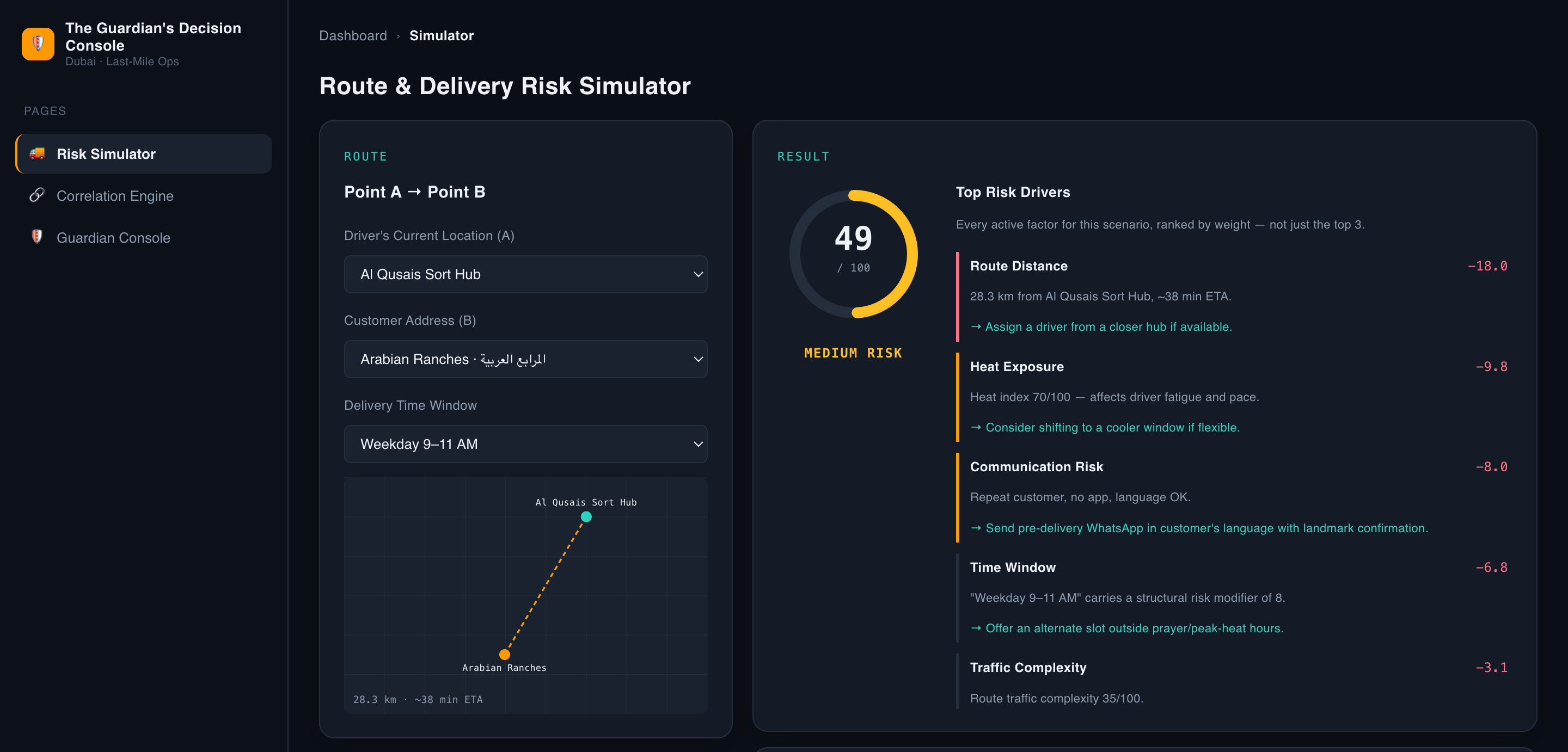
Last-mile delivery in Dubai fails for boring, structural reasons — a low address-match rate in a residential cluster, a driver circling a warehouse with no signage, a customer who can't be reached because their preferred contact channel has a low response rate. Most dispatch tools log these failures after the fact. Dispatch Guardian scores the risk before the driver even leaves the hub, and decides what to do about it
The hard part is that risk factors don't just add up — they compound. A wrong address alone is a minor problem; paired with a customer who has no app and doesn't respond to SMS, it's a near-guaranteed failed delivery. The Correlation Engine models these interactions directly: eleven factor pairs, each tagged as compounding or mitigating with its own strength, so two factors in a known-bad pairing produce a synergy penalty beyond their simple sum.
That correlation data isn't decorative — it's what the Guardian actually reasons with. Instead of handing a human a checklist, it decides for itself whether to act, scoring every intervention on stakes (cost of being wrong) and confidence. Confidence is grounded: it rises when active factors match a known compounding pattern, and drops when several factors are active with no modeled relationship between them. The result sorts into auto-execute, execute-and-log, or escalate-to-human, across three tunable autonomy levels.
highlights
- 11-factor delivery risk model using real Dubai hub/area data
- Correlation Engine modeling how risk factors compound together
- Decides whether to fix a problem, log it, or ask a human — before dispatch
- Estimates how the customer feels about it — before the delivery even happens
- React
- Client-side scoring engine
- netlify